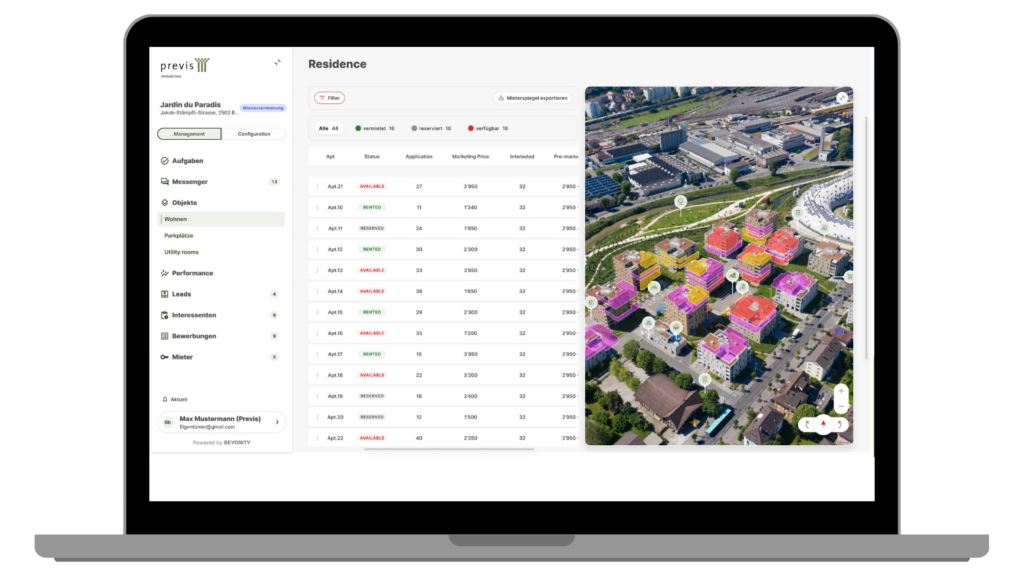
HELLO OS is the system behind BeyonityHELLO®. It joins ERP, CRM and customer interaction across all Beyonity products into one continuous flow: from the first click to the e-signature. No switching between systems, no handovers by spreadsheet, no lost leads. This post sets out why and how HELLO OS differs from just another tool in the stack: the three pillars it rests on, the ten modules it is built from, and the data loop with the Navigator that turns all of it into real value for property companies.
Key takeaways
- HELLO OS is not simply another property marketing solution. It is the data core between ERP, CRM and customer interaction — for first lease-ups, re-leasings, commercial leases and the sale of condominium units alike.
- Three pillars carry the system: a continuous application flow through to the e-signature, pipeline intelligence with an intent score you can follow, and decision logic that gives a reason for every recommendation — and that you can overrule at any time.
- In a first pilot, BeyonityHELLO reached 26.3% lead-to-tenant conversion (against an industry average of 0.4–1.2%, NAR benchmark), and 30.6% of the new-build apartments (45 of 147) had been signed digitally by tenants 48 hours after marketing began.
Three pillars
HELLO OS rests on the following three pillars:
- Click-to-Contract: one continuous digital flow from the first visit to the e-signature — credit check, profile matching, contract generation and signature in a single digital application. In the BeyonityHELLO® pilot, the fastest measured route to a signed contract was under 120 seconds. Zero friction at the decisive moment.
- Pipeline intelligence: the funnel that used to be invisible becomes visible. You see not only how many leads are in play, but why they stayed or left. Every drop-off gets a reason, every conversion an intent score: the result is a reliability figure you can forecast against.
- Decision logic you can follow: every recommendation the system makes comes with its reasoning. Which signals triggered it? Which rule did HELLO OS weight more heavily? Which alternative was discarded? The last word stays with people: every decision the system makes can be inspected and overruled. And the model learns from that.
New build and existing stock: different starting points, the same data core
HELLO OS treats a first lease-up and an existing property differently, because the starting points differ: a new build has no history for a system to draw on, while for an existing property that history is already held in the ERP system.
For the first lease-up of new builds, HELLO OS is therefore the authoritative data source itself. Units, prices and infrastructure data are created and maintained natively in the system. HELLO OS steers the entire marketing process, from the first price range through marketing in the Navigator® to the signed contract.
For existing properties the roles reverse. The ERP system in place remains the authoritative source, and HELLO OS takes on the role of executor: it listens for signals from the ERP and acts on them automatically. For example: when a unit is given notice in the ERP, HELLO OS switches it to available and marketing in the Navigator® starts without a manual step in between. A signed contract, like a notice to vacate, flows straight back into your system.
For you that means no maintaining the same data twice, and no laborious spreadsheet handovers between marketing and management.
Ten modules, one system
HELLO OS is one system with ten modules, and each of them meshes with the next. Pricing listens to the signals, matching listens to pricing, the agent listens to the pipeline. On top of that, HELLO OS keeps learning while it runs. The modules:
- Pricing. HELLO OS adds real demand signals to pricing, giving you a further basis for market-based prices within defined ranges. The final decision stays with people.
- Pipeline intelligence. More than 10 seconds on the cost breakdown means price sensitivity; less than 5 seconds on the floor plan means the product does not fit; interaction with the map points to the location not fitting. Every drop-off gets a reason, every conversion an intent score.
- ERP integration. When a unit is given notice in your ERP system, HELLO OS switches it to available at once. Marketing in the Navigator® starts automatically. For new builds HELLO OS is the leading data source; in existing stock it listens and executes.
- Tenant selection. Owners define the target mix — for example 50% families, 30% couples, 20% single occupants, depending on the owner’s strategy. The AI rates every applicant on creditworthiness, profile match and fit with the property. Those who improve the mix are given priority in the selection.
- Consumer journey. Application, credit check, fit with the tenant mix, contract generation and e-signature run automatically, one after the other. At best, only minutes pass between a move-out and the new lease.
- Cross-selling. A lead who is keen on one property may only really fit the third. HELLO OS matches existing leads against every suitable unit across the portfolio — and does so before they drop out after a rejection. The owner’s consent is preserved throughout, in line with the GDPR.
- Journey optimization. A visual canvas maps every moment of the marketing journey, from the first Navigator interaction to the signature — with best-practice defaults from day one. Prospects who receive a nudge within 60 minutes of a high-intent interaction apply three times as often.
- Guiding customers. Like Amazon in e-commerce, we run continuous experiments to improve conversion: in how we address people, in new features, and across the whole application process.
- Reporting. A performance cockpit connects Navigator signals (time spent, sun simulation, interest in the floor plan) with the application funnel through to the signed contract. Every data point comes with a recommended next action: adjust the price, prioritize the lead, remove friction from the journey.
- HELLO Agent. The AI assistant takes on the operational work behind the scenes: checking documents, nudging for missing information, verifying references, spotting anomalies. It escalates only when confidence is too low or negative signals appear. Your team steps in only where human judgment is called for.
In closing
What BeyonityHELLO® offers property marketing is the way the products connect inside one closed ecosystem. The Navigator® generates the signal: behavior, intent, intensity of demand and reasons for dropping off are fed into the processing layer as a live event stream, not in retrospect. HELLO OS acts on that signal: pricing decisions, mix scoring, candidate ranking, automation triggers. And the pipeline intelligence flows back into the Navigator’s recommendations.
A single resident identity carries that loop: one profile travels with the user from the first swipe to the signed contract, through the Navigator and HELLO OS. Within BiG OS — the shared digital ecosystem of Beyonity, imofix.io and GARAIO REM, which is driving the lasting digital transformation of property management — the same profile travels on to the last damage report or rent payment. No data lost, nothing entered twice.
Experience HELLO OS using your own projects.
Source: Beyonity, 2026 (HELLO OS and BeyonityHELLO® pilot: 26.3% lead-to-tenant conversion, 30.6% signed digitally by tenants within 48 hours, <2 min from application to e-signature; NAR benchmark of 0.4–1.2% lead-to-deal conversion as the industry comparison).