Five micro-interactions in digital real estate marketing reveal genuine readiness to rent: returning to the floor plan, using the map, the speed of registration, behavior on the cost breakdown, and saving a search profile.
A classic project website holds prospects for around 90 seconds. They skim a few images of the property and click away. In the Beyonity Navigator, those same prospects now stay for over 12 minutes on average: exploring units, comparing, checking costs, saving search profiles. Every one of those actions in the digital marketing space is a signal. Together they build a picture of readiness to rent that a completed contact form could never match for accuracy. This post sets out which micro-interactions really make a real estate readable, how individual clicks add up to a pattern, and how to turn that into concrete marketing decisions.
Key takeaways
- A contact form says little about genuine readiness to rent. Behavior in the digital marketing space gives a sharper picture.
- Five micro-interactions carry particular weight: returning to the floor plan, interacting with the map, the speed of registration, behavior on the cost breakdown, and saving a search profile.
- The pattern of behavior turns into concrete decisions: which leads to prioritize, when to make first contact, and how to adjust the offering and the pricing logic.
The form alone is no longer enough of a signal
In many sales teams a completed contact form still counts as the leasing signal. In practice it says little about genuine readiness to rent. One prospect enters their details because they want to download the brochure. Another fills in the form at the end of long research in which they have already settled on a particular unit. Both appear in the CRM as equivalent leads. To the sales team they are nothing of the sort.
The information that matters lies between the first click and the form:
- How often has the prospect visited the digital marketing space?
- Which unit did they spend longest on?
- Did they save a search profile?
Five micro-interactions reveal genuine readiness to rent
Not every interaction tells you the same amount. Analyzing real prospect journeys in the Navigator, five kinds of signal have proved particularly reliable.
- Returning to the floor plan. Anyone who opens the same floor plan more than three times has begun to make the apartment their own in their head — a pattern the signal analysis treats as mental ownership.
- Interacting with the map. Anyone who turns to the area map after a first look at the unit and then leaves is signaling that the location does not fit: the apartment works, the address does not. A cue for the sales team to point to alternative locations in the portfolio.
- Speed of registration. Anyone in the fastest 10% to register is showing the greatest urgency and resolve.
- Behavior on the cost breakdown. Anyone who lingers only seconds on the cost breakdown and then breaks off is signaling price sensitivity: a warning to the sales team that calls for a quick follow-up.
- Search profile or waiting list. Anyone who saves a search profile or joins a waiting list although the right unit is not available shows lasting rather than passing interest: a lead who stays, even when what is on offer today does not fit.
Individual signals add up to a reliable pattern
One signal on its own is not enough. Two together start to be interesting. Four or five on the same unit make a pattern the sales team can act on with facts in hand.
An example from practice: a prospect opens the floor plan of apartment 4.02 four times within a week. On the second visit their registration is among the fastest 10%, a sign of real urgency. On the third they also save a search profile for comparable units in the same building. The following Sunday they come back and open the floor plan full screen.
Observation becomes a marketing decision
Behavioral data is not an end in itself. Its value lies in the decision that follows. Reading micro-interactions changes three levels of decision.
Prioritizing leads. Instead of working through every contact in the same order, the sales team sorts by the density of signals. A prospect with five micro-interactions on one unit is contacted at once. A prospect with a single short visit stays in nurturing.
The phone call becomes the exception. Through HELLO OS a prospect signs the lease online: no call at all, from the first click to the signature. The sales team steps in only where the signals show something genuinely needs clearing up — a price warning on the cost breakdown, say, or a prospect dropping out just short of closing.
Sharpening the offering and the pricing logic. When managers and asset managers see that certain units are visited often but never turn into a search profile or an application, that points to a weakness in the offering. HELLO OS adds the real demand signals from the Navigator to pricing, giving a further basis for market-based prices within defined ranges. The final decision stays with people.
None of this is theory. The Navigator is in use in over 600 projects worldwide, in 9 languages. Prospects stay active in the product for 12 minutes on average, against around 90 seconds on a classic project website, at an average conversion rate of 4.43% on the number of visitors.
The Navigator makes the signals visible
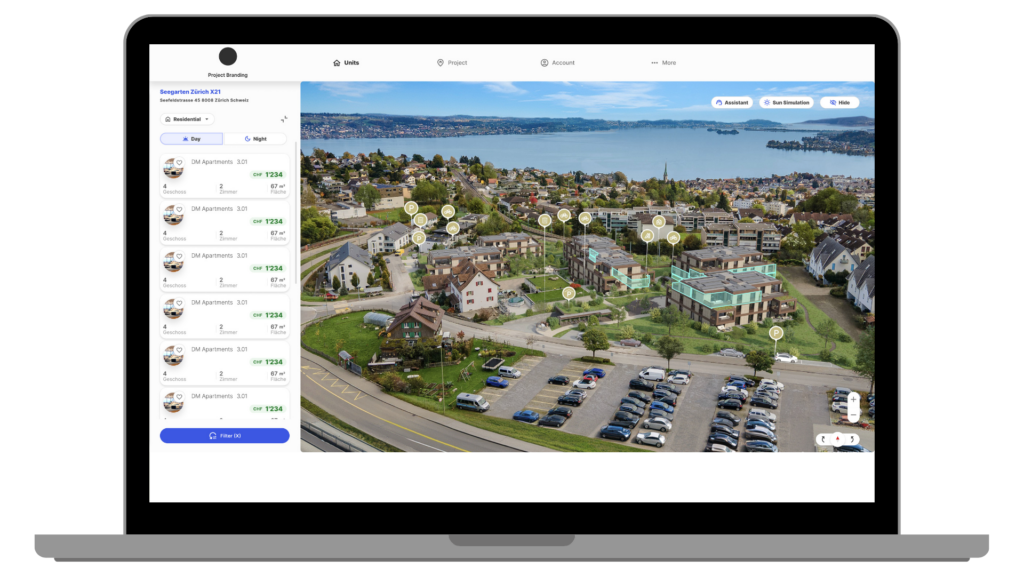
The five micro-interactions only arise once the prospect enters a digital space that gives them control. The Navigator is that space: the marketing space in which a prospect moves through units, floor plans, cost breakdowns and search profiles around the clock. Every move is recorded.
And the Navigator accompanies a project across its whole lifecycle: from analyzing demand before ground is broken, through pricing against real prospects and automated sales, to the existing stock, where demand pressure and portfolio-wide matching keep the real estate alive long after the project is complete.
In closing
A contact form opens a conversation. Micro-interactions show which conversation to have. Five signals carry particular weight in the digital marketing space: returning to the floor plan, interacting with the map, the speed of registration, behavior on the cost breakdown, and saving a search profile. Together they form a pattern the sales team can prioritize on facts. The Navigator is what makes the interactions possible.
See the Navigator in action
In a 30-minute live demo we go through your current marketing situation. Using real client projects, you see how the Navigator and HELLO OS make the five micro-interactions from this post visible for your own units. And you see how your sales team turns a behavioral profile into a priority order it can rely on.
Source: Beyonity, 2026 (Navigator product figures: ∅ 12 min visit time, 4.43% ∅ conversion rate on the number of visitors, +600 Navigators in use worldwide, 9 languages; signal analysis from the Navigator usage data).